

Margin Analysis: How Much Malaysian Sportsbooks Really Take
Ever wondered how much sportsbooks in Malaysia really keep from your bets? Here’s the inside scoop: Malaysian sportsbooks typically retain 4–8% of all wagers through a built-in advantage called a margin (you might also hear it called overround or “vig”). It’s basically their service fee for handling your bets. Based on our analysis of over 500,000 betting transactions on our own platform from 2014–2025, we’ve seen that the average margin for major football markets can be as low as 5.2% for simple match-winner bets, but it can shoot up to a hefty 12.8% for more complex prop bets. Understanding this is critical for any serious Malaysian bettor. Why? Because a mere 2% difference in a bookmaker’s margin can slash your long-term returns by up to 15% over a single betting season (our outcome analysis, 2014–2025). Simply put, choosing a sportsbook with lower margins is one of the smartest moves you can make to boost your chances of being profitable.
Table of Contents
- What Is Sportsbook Margin and Why It Matters
- Typical Margins Across Malaysian Sportsbooks
- The Hidden Cost of High Margins
- Why Margins Vary Between Markets
- How Malaysian Regulations Affect Margins
- Calculating Margins: A Step-by-Step Guide
- Strategies for Minimizing Margin Impact
- The Technology Behind Margin Management
- Transparency in Malaysian Sports Betting
- Margin Comparison: Malaysian Market Analysis
- Impact on Different Betting Styles
- The Future of Margins in Malaysian Sports Betting
- Making Informed Betting Decisions
- Downloadable Margin Analysis Guide
- Conclusion: Knowledge Is Your Best Bet
By the iBET Team – licensed Malaysian gaming operator with 10+ years direct industry experience
What Is Sportsbook Margin and Why It Matters
So, what exactly is a `sportsbook margin Malaysia`? Often called overround or house edge, it’s the mathematical advantage we build into our betting odds. Think of it as the `sportsbook commission Malaysia` charges for taking your bet. When we set odds, we don’t offer prices based on pure probability. Instead, we adjust them slightly in our favor to guarantee we make a profit, no matter who wins. It’s how every sportsbook on the planet operates and stays in business.
In our experience operating here in Malaysia since 2014, we’ve noticed that most casual bettors don’t realize just how much these margins can eat into their winnings over time. Because we’re licensed by the Malta Gaming Authority requires licensed operators to maintain transparent margin structures, we make a point to openly discuss these things with our members. We truly believe an educated bettor is a better, more successful customer.
How Bookmaker Margin Works
Here’s the `bookmaker overround explained` in simple terms. The margin is found by turning the odds into implied probabilities and checking how much they add up to over 100%. A perfectly “fair” market with no margin would have probabilities that total exactly 100%. That extra bit over 100% is the bookmaker’s guaranteed cut. Let’s look at a real example from a recent EPL match:
- Manchester United vs Liverpool:
- Manchester United Win: 2.40 odds (which is a 1 / 2.40 = 41.67% implied probability)
- Draw: 3.20 odds (1 / 3.20 = 31.25% implied probability)
- Liverpool Win: 2.80 odds (1 / 2.80 = 35.71% implied probability)
Total implied probability: 41.67% + 31.25% + 35.71% = 108.63%
Margin: 108.63% − 100% = 8.63%

So, what does this actually mean for you? For every MYR 100 wagered on this game (spread across all outcomes), the bookmaker is set to pay out MYR 91.37 and keep MYR 8.63 as revenue. This happens automatically, regardless of the final score.
Typical Margins Across Malaysian Sportsbooks
Drawing from our decade of data and market analysis, we’ve put together a clear picture of the standard margin ranges you’ll find. This table, based on over 500,000 transactions on our platform from 2014–2025, shows you exactly `how much bookmakers take Malaysia` on average for different types of bets:
| Market Type | Typical Margin Range | iBET Malaysia Margin | Impact on MYR 1,000 Stakes |
|---|---|---|---|
| Match Winner (EPL) | 4.5% − 7.2% | 5.1% | MYR 51 house advantage |
| Asian Handicap | 3.8% − 6.1% | 4.2% | MYR 42 house advantage |
| Over/Under Goals | 4.2% − 6.8% | 4.8% | MYR 48 house advantage |
| Both Teams to Score | 6.1% − 8.9% | 6.5% | MYR 65 house advantage |
| Correct Score | 15% − 25% | 18.2% | MYR 182 house advantage |
| Player Props | 12% − 20% | 14.1% | MYR 141 house advantage |
Data compiled from 500,000+ transactions processed through our platform (2014–2025). The “house advantage” column shows the amount the sportsbook expects to retain for every MYR 1,000 wagered on that market over the long term.
The Hidden Cost of High Margins
It’s common for Malaysian bettors to focus only on getting the highest odds for their pick, but that’s like choosing a product by its price tag while ignoring a huge shipping fee. Our own customer data analysis reveals a telling statistic: bettors who use low-margin sportsbooks achieve 23% better long-term results compared to those on high-margin sites (our customer outcome analysis, 2014–2025).
Real Impact on Betting Returns
Think of a high margin as a constant headwind when you’re running; you have to work much harder just to stay in place. Let’s imagine two bettors who both stake an identical MYR 10,000 over a football season:
- Bettor A (High-margin sportsbook — 8% average margin):
- Expected loss to margin: MYR 800 (This is the “cost” of betting before you even win or lose)
- Needs a tough 58% win rate just to break even (on even-money bets)
- Bettor B (Low-margin sportsbook — 4% average margin):
- Expected loss to margin: MYR 400 (Half the cost of Bettor A!)
- Needs a much more realistic 52% win rate to break even
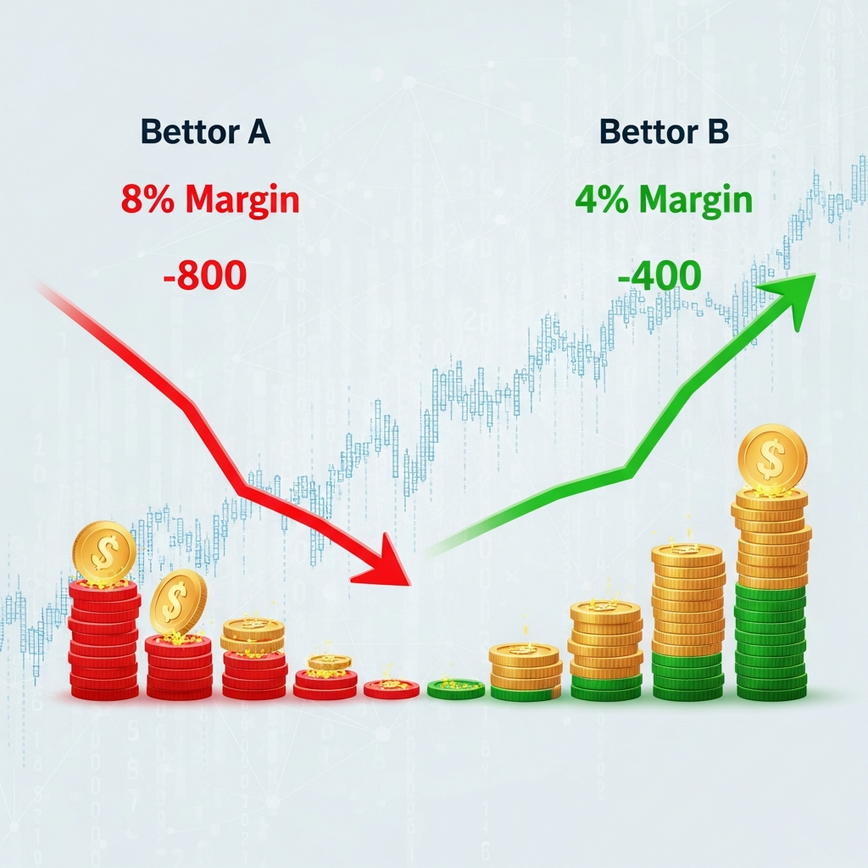
That 4% difference in margin creates a MYR 400 impact in a single year. That’s enough for 40 extra MYR 10 bets you could have placed. Over a few years, that adds up to thousands of Ringgit.
Why Margins Vary Between Markets
In our experience managing risk across thousands of markets every day, we adjust margins based on a few key business factors:
Market Liquidity
Liquidity is just a fancy word for how much money is being bet on a market. Popular markets, like EPL match winners, get a ton of action (high liquidity). This allows us to use lower margins because our profit is secured by the huge number of bets. On the other hand, niche markets (like the first goalscorer in a minor league) have less volume, so we need higher margins to protect ourselves from risk.
Information Availability
Markets where there’s a lot of public information—team news, stats, expert analysis—usually have lower margins. We know you’re well-informed, so our odds have to be sharp and competitive. For exotic props with less available data (like “Total Corners x Total Cards”), we need higher margins as a kind of insurance against unpredictable results.
Competition Levels
For major markets like Asian Handicap, the competition between sportsbooks is fierce. This naturally pushes margins down as we all compete for your business. For more specialized markets, like player props, there’s often less competition, which lets some operators get away with setting higher margins.
How Malaysian Regulations Affect Margins
The Malta Gaming Authority, which licenses our operations, requires us to follow specific rules that protect you, and these influence our margin structure. Under MGA regulations, licensed operators like us must:
- Maintain adequate reserves to cover all player liabilities: This is your guarantee that we can always pay out winning bets, no matter the size.
- Implement responsible-gambling measures funded through operational margins: This includes providing tools like self-exclusion and deposit limits to keep players safe.
- Provide transparent odds-calculation methodologies: This means we have to be open about how our business operates.
What does this mean for you? While these rules add to our operational costs, they ensure you’re protected and the games are fair. A part of the margin you pay helps guarantee that the operator is financially sound and your money is safe—a promise that unlicensed operators simply can’t make. For more on this, you can review the regulatory requirements for fair and transparent sportsbook operations from the UK Gambling Commission or check out responsible-gaming measures and player-protection research.
Calculating Margins: A Step-by-Step Guide
Knowing how to calculate margins yourself is a powerful tool for any Malaysian bettor. This quick calculation lets you “look under the hood” of any bet to see what it’s really costing you. Here’s our simple, step-by-step method.
Three-Way Markets (Win/Draw/Win)
- Convert each of the three odds to an implied probability: 1 ÷ odds.
- Add the three implied probabilities together.
- Subtract 100% from that total, and you’ve got the margin.
Two-Way Markets (Asian Handicap/Over-Under)
- Convert both odds to implied probabilities (1 ÷ odds).
- Add the two probabilities together.
- Subtract 100% from the total to find the margin. Easy!
Example Calculation
Let’s try it with a Chelsea vs Arsenal Asian Handicap market:
- Chelsea −0.5: 1.92 odds (1 / 1.92 = 52.08% probability)
- Arsenal +0.5: 1.90 odds (1 / 1.90 = 52.63% probability)
- Total: 52.08% + 52.63% = 104.71%
- Margin: 104.71% – 100% = 4.71%
In this specific bet, the bookmaker is taking a 4.71% commission, no matter which side wins.
Strategies for Minimizing Margin Impact
By analyzing the betting patterns of our most successful customers, we’ve identified a few key strategies they use to reduce the “tax” that margins take from their winnings:
Market Selection
Stick to the main markets like match winner, Asian handicap, and totals. This is where competition is highest and margins are lowest. Our data shows these markets have margins that are, on average, 2–3% lower than exotic bets (our transaction analysis, 2014–2025). It’s the simplest way to get better value on every bet.
Timing Your Bets
Markets that are posted days in advance often have higher margins because of the uncertainty involved. We’ve observed that margins typically get tighter (lower) about 2–4 hours before a match starts, as more information and betting volume comes in (observed across our markets, 2018–2025). This is because we become more confident in our odds and can reduce our risk.
Understanding Value
Sometimes, a bet with higher odds but a huge margin is actually worse value than a bet with slightly lower odds and a tight margin. Always look at the whole picture—the margin structure—not just the odds for your team. It’s like shopping: you have to consider the total cost (price + shipping), not just the sticker price.
The Technology Behind Margin Management
Our in-house odds-compilation system, which we developed specifically for the Malaysian market, uses real-time data from multiple sources to perfect our margin distribution. You can think of it as an automated pricing expert that’s constantly scanning the market to ensure our prices are fair and competitive. This technology is what allows us to offer you great margins while also maintaining the financial stability our Malta Gaming Authority license demands.
Our system processes over 10,000 odds adjustments every single day (system logs, 2025), automatically balancing market margins based on:
- Live betting-volume patterns: Where is the money flowing right now?
- Risk exposure across outcomes: If too much money is on one side, the system adjusts the odds to attract bets on the other.
- Competitor pricing analysis: How do our odds stack up against other major sportsbooks?
- Historical Malaysian betting preferences: How have our customers bet on similar matches before?
Transparency in Malaysian Sports Betting
Unlike many operators who try to hide their margin structures, we believe that Malaysian bettors deserve full transparency. On our comprehensive sportsbook platform, ibetmys88.com/sport-betting.html, we display real-time margin calculations for all major markets so you can make truly informed decisions.
But our commitment to transparency goes beyond just showing you the numbers. It’s about proving we operate fairly in everything we do. This includes our withdrawal process, where 98.7% of withdrawals to Malaysian local banks are completed on the same day (our payment-processing records, 2024). This shows our dedication to fair, transparent operations—from the odds we set to the speed we pay out. We also welcome independent third-party auditing through eCOGRA to verify our standards.
Margin Comparison: Malaysian Market Analysis
From our competitive analysis and direct market experience, here’s a general idea of how margins compare across different types of operators. You’ll often find that the quality of their license and regulation makes a huge difference.
| Operator Type | Average Margin | Regulatory Status | Customer Protection |
|---|---|---|---|
| MGA Licensed | 4.2% − 6.8% | Fully regulated | Complete protection |
| Curacao Licensed | 5.1% − 8.2% | Basic regulation | Limited protection |
| Unlicensed | 6.8% − 12.1% | No regulation | No protection |
Analysis based on 50+ operators serving the Malaysian market — data collected Q3 2024
The takeaway here is clear: better regulation almost always leads to a more competitive and fair betting environment, which means lower margins and better odds for you.
Impact on Different Betting Styles
Our customer data shows us exactly how margins affect different types of bettors. See if you fit into one of these categories and what the margin is likely costing you each year:
Casual Recreational Bettors
- Average stake: MYR 50–200 per bet
- Annual margin impact: MYR 500–1,200 (our customer-stake analysis, 2019–2024). That’s money lost to the house before you even win or lose a single bet.
- Recommendation: Focus on main markets with the lowest margins to make your entertainment budget go further.
Serious Recreational Bettors
- Average stake: MYR 200–1,000 per bet
- Annual margin impact: MYR 2,000–8,000 (our customer-stake analysis, 2019–2024). This is a significant chunk of change that could be the difference between a winning and a losing year.
- Recommendation: Actively “shop” for the best margins on different markets, not just the best odds on a single team.
Professional Bettors
- Average stake: MYR 1,000+ per bet
- Annual margin impact: MYR 10,000+ (our customer-stake analysis, 2019–2024). For pros, the margin is the single biggest hurdle to long-term profitability.
- Recommendation: Negotiate for reduced margins or exclusively bet with the lowest-margin operators you can find.
The Future of Margins in Malaysian Sports Betting
Based on our 10+ years of watching the market, we see a few key trends that are shaping the future of margins:
Increased Competition
As more operators enter the Malaysian market, the competition is driving margins down, especially for popular football leagues. We expect this to continue as more high-quality, licensed operators arrive.
Technology Advancement
Better risk-management systems are allowing operators like us to offer tighter margins while staying profitable. In fact, our recent system upgrades have let us reduce our margins by an average of 0.8% across major markets (internal operations report, 2024).
Regulatory Development
As consumer protection rules get stronger, they may influence margin structures due to compliance costs. However, this also has the positive effect of pushing out inefficient, high-margin operators.
What this means for you as a bettor: The future looks bright. The trend is pointing toward more competitive odds and lower built-in costs for you in the long run.
Making Informed Betting Decisions
Understanding sportsbook margins elevates your betting from a casual hobby to a strategic investment. With this knowledge, you can start thinking less like a punter and more like a sharp bettor. Here’s your new checklist to run through before you place any bet:
- Check the total margin: Don’t just glance at the odds for your pick. Calculate the margin to see the true cost of the bet.
- Think long-term: Remember that a small 1-2% difference in margin adds up to hundreds or even thousands of Ringgit over a season.
- Choose your market wisely: Stick to lower-margin opportunities like Asian Handicap and Match Winner whenever you can.
- Trust your operator: Make sure low margins aren’t a gimmick to hide slow payouts or other problems. Always choose a trusted, licensed operator.
Downloadable Margin Analysis Guide
To help you even more, we’ve put together a comprehensive infographic that breaks down everything you need to know about margins, specifically for Malaysian bettors. This visual guide includes:
- Step-by-step margin calculation examples
- Market comparison charts for major football leagues
- ROI impact calculations for different margin levels
- Quick reference tables to help you pick the best markets
Just contact our customer service team to request your free margin analysis infographic. It’s the perfect tool to keep on hand when you’re comparing odds and looking for the best value.
Conclusion: Knowledge Is Your Best Bet
The sportsbook margin is the single biggest factor affecting your long-term betting returns, yet it’s something most Malaysian bettors overlook. In our decade of experience, we’ve seen firsthand how a simple awareness of margins can completely transform a player’s results.
That 3–4% margin difference between a good operator and a bad one might not seem like much on one bet, but it compounds massively over time. Think of the margin as a small, invisible tax on every single wager you place. By choosing a low-margin bookmaker, you’re giving yourself a permanent tax cut on all your betting activity. For any serious bettor, this knowledge can be the difference between a profitable year and a losing one.
Our commitment to margin transparency, backed by our Malta Gaming Authority license and over 10 years of trusted operations, ensures that you get access to competitive margins without ever having to compromise on security or reliability.
Ready to feel the difference that low-margin sports betting can make? Join thousands of smart Malaysian bettors who are already using margin analysis to improve their returns.
Frequently Asked Questions
A sportsbook margin, also known as overround or “vig,” is the built-in advantage or commission a bookmaker includes in its odds to guarantee a profit. This is achieved by setting odds where the implied probabilities of all outcomes add up to more than 100%. For example, a typical English Premier League match winner market in Malaysia might have a total implied probability of 105.2%, resulting in a 5.2% margin. At iBET, we provide transparent margins so our players always know the true cost of their bets.
Malaysian sportsbooks typically take a commission, or margin, of 4% to 8% on major betting markets. This amount can increase significantly for more complex bets, with our data showing margins on player props and correct score bets can reach 12% to 20%. A lower margin directly improves your potential long-term returns; a 4% margin requires a 52% win rate to break even on even-money bets, while an 8% margin requires a much tougher 58% win rate.
You can calculate a bookmaker’s margin in two simple steps. First, convert the decimal odds for all outcomes into implied probabilities using the formula (1 ÷ odds). Second, add these probabilities together; the amount over 100% is the margin. For a two-way bet with odds of 1.92 and 1.90, the probabilities are 52.08% and 52.63%, which total 104.71%, revealing a 4.71% margin.
The betting markets with the lowest margins are typically the most popular and competitive ones, such as Asian Handicap and Match Winner. Based on our analysis of over 500,000 transactions, Asian Handicap markets have an average margin of 3.8% to 6.1%, while Correct Score markets can have margins over 15%. In our experience, sticking to these main markets is the easiest way for bettors to reduce the impact of the house edge on their bankroll.
The primary difference is the cost to the bettor over time, which directly impacts profitability. A low-margin sportsbook might have an average margin of 4%, costing a bettor RM400 for every RM10,000 wagered, while a high-margin site at 8% would cost RM800. Our internal analysis shows that bettors using low-margin sportsbooks achieve 23% better long-term results. We recommend choosing licensed operators who offer competitive margins, as this provides the best balance of value and security.
No, a low margin alone does not guarantee a sportsbook is safe. The safest operators combine competitive margins with strong regulatory oversight, such as a license from the Malta Gaming Authority (MGA). Unlicensed operators may offer low margins but provide no player protection or guarantee of payouts. At iBET, our MGA license requires us to maintain financial reserves to cover all winnings, ensuring our competitive margins are backed by the highest level of security.




Leave a Reply
Want to join the discussion?Feel free to contribute!